

Two of the most persistent and costly challenges in commercial vessel maintenance are corrosion and biofouling. Both are permanent consequences of operating a metal vessel in a marine environment, and both can be managed effectively with the right approach. This article provides a technical overview of the principal methods and the considerations that guide system selection.
Corrosion in the Marine Environment
The salt water environment creates aggressive electrochemical conditions for metal vessel structures and fittings. The primary mechanism relevant to vessel operators is galvanic corrosion, which occurs when two dissimilar metals are in electrical contact in an electrolyte (sea water). The less noble metal (the anode) corrodes preferentially to protect the more noble metal (the cathode).
In practical terms, this affects propellers, shafts, rudders, hull plating, sea chests, and any fitting where different metals are in contact. Left unmanaged, galvanic corrosion causes accelerated material loss in vulnerable components.
Sacrificial Anode Cathodic Protection
The simplest and most widely used cathodic protection method for smaller commercial vessels and leisure craft is the sacrificial anode system. Zinc, aluminium, or magnesium anodes are attached directly to the hull, propeller, and shaft. Being less noble than the vessel’s steel or aluminium structure, the anodes corrode preferentially, sacrificing themselves to protect the base metal.
The selection of anode material depends on the vessel’s operating environment. Zinc anodes are standard for salt water service. Aluminium anodes offer greater energy density and are preferred in warm salt water where zinc performance decreases. Magnesium anodes are used in fresh water, where the lower conductivity of the electrolyte requires a more active material.
Anodes must be inspected and replaced before they are consumed to more than approximately 50 percent. A fully consumed anode provides no protection.
Impressed Current Cathodic Protection (ICCP)
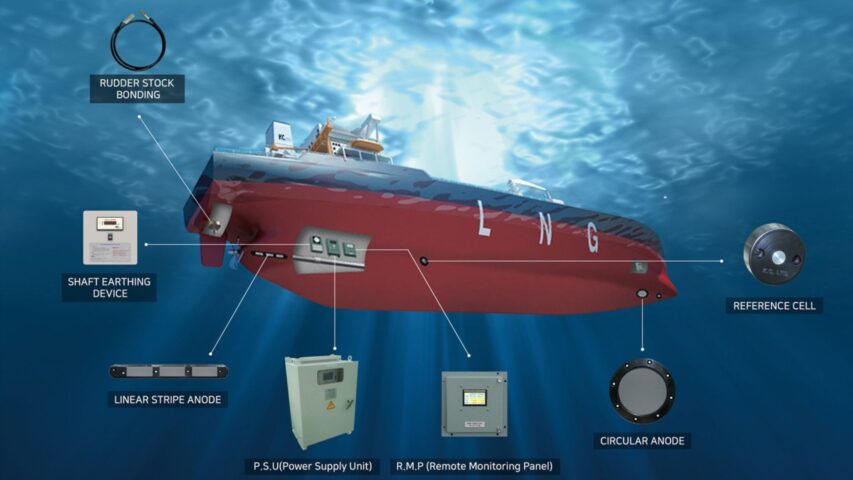
For larger commercial vessels, ICCP systems apply a controlled direct current to the hull via inert electrodes, counteracting the galvanic current and eliminating sacrificial corrosion. ICCP eliminates the need for regular anode replacement and provides more consistent protection across large hull areas.
The system requires a reference electrode to monitor hull potential and a control unit to adjust the applied current automatically. ICCP is standard on most vessels above approximately 50 metres and is increasingly applied to smaller commercial workboats where the maintenance savings justify the installation cost.
Antifouling
Biofouling within a vessel’s internal seawater systems presents a serious operational risk. Barnacles, mussels, and other marine organisms enter pipework as larvae through sea chests and strainers, where they settle, grow, and multiply rapidly on the internal surfaces of pipes. In the most extreme cases, seawater lines can become completely blocked, directly affecting the safety and operational capability of the vessel. More commonly, the gradual restriction of seawater flow through cooling systems impairs engine efficiency, leading to increased fuel consumption and elevated maintenance costs.
The KC Ltd Marine Growth Prevention System (MGPS) ANFOSYS addresses this problem at source using the electrolytic principle. The system consists of copper, aluminium, and ferrous anodes fed with an impressed electrical current from a dedicated control panel. The anodes are mounted in pairs within the vessel’s sea chest or strainer, placing them in direct contact with the seawater flow entering the pipework system. Where space or configuration requires it, anodes can alternatively be mounted on an independent treatment tank.
In operation, the copper anode releases ions which are transported by the seawater and carried throughout the pipework and all equipment beyond. Copper ion concentrations of less than two parts per billion are sufficient to prevent marine organisms from settling and multiplying within the system. Simultaneously, the aluminium and ferrous anodes release ions that spread through the pipework and form a protective anti-corrosive layer on the internal surfaces of seawater cooling lines. The result is complete and continuous protection for pipework, valves, condensers, firefighting equipment, refrigeration systems, and air conditioning units throughout the vessel.
The ANFOSYS control panel provides digital current monitoring with high and low current alarms, adjustable current settings from 0.1A to 9.9A, and straightforward integration with a vessel’s automation monitoring system. Anode replacement is designed for minimal downtime: genuine KC Ltd spare anodes are supplied as complete pre-assembled sets, allowing renewal in approximately ten minutes per piece without specialist tooling. The system is fully compliant with EU Directive requirements and has been supplied to over 12,000 vessel worldwide.
KC Ltd: Cathodic Protection and Antifouling Solutions
Watermota partners with KC Ltd for cathodic protection and marine growth prevention system supply. The KC Ltd range covers sacrificial anodes, ICCP system components, and the ANFOSYS MGPS for commercial and leisure vessels. Our team can advise on system selection and supply for both new builds and maintenance applications.
Contact Watermota to discuss cathodic protection and antifouling requirements for your vessel.